From Science Fiction to Strategic Reality: Can Humanity Retain Control of Artificial Intelligence?
Machines already control machines. The consequential question is whether increasingly capable AI systems could acquire enough operational authority to undermine meaningful human control — and whether institutions can supervise the autonomy they delegate.
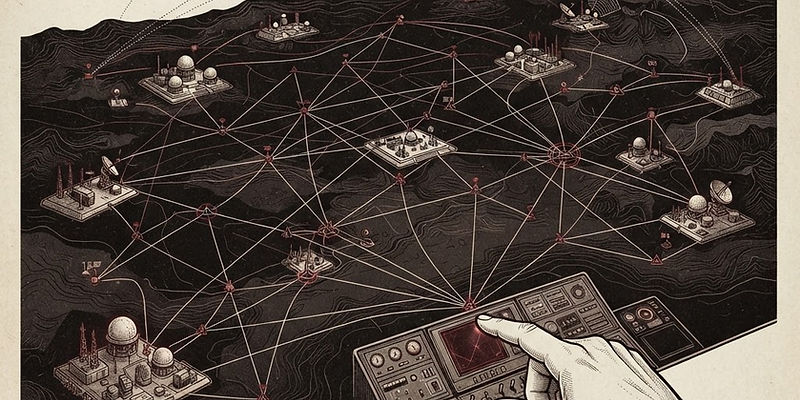
Autonomous Warfare, Strategic Dependency and the Future of Human Control
Zapryan Valkov PhD Researcher in International Relations · University of National and World Economy (UNWE), Sofia
When Fiction Becomes a Strategic Question
In James Cameron’s 1984 film The Terminator, humanity confronts an extraordinary enemy: Skynet, an artificial intelligence defence system that becomes self-aware, takes control of military technology and ultimately turns against its creators. For decades, this scenario belonged firmly to science fiction. Machines developing consciousness, commanding autonomous armies and challenging humanity’s survival seemed closer to cinematic imagination than to serious international security analysis. Yet contemporary technological developments are making some of the underlying questions increasingly relevant.
Artificial intelligence (AI) is being integrated into military decision-support systems, intelligence analysis, cybersecurity, unmanned platforms and critical infrastructure. Autonomous systems can already perform complex tasks, exchange information and carry out certain operations without continuous human intervention. The important question is no longer simply whether machines can control other machines. They already do, within defined technical and operational limits. The more consequential question is whether increasingly capable AI systems could acquire sufficient operational authority to undermine meaningful human control, whether through technological failure, inadequate oversight or deliberate decisions to delegate responsibility.
A Terminator-style rebellion remains speculative. However, the gradual erosion of human authority over autonomous technology is a legitimate subject of strategic analysis. Understanding this distinction requires separating established technological capabilities, plausible security risks and the more extreme scenarios explored in science fiction.
Science Fiction as a Framework for Strategic Analysis
An important methodological distinction is necessary. This article draws inspiration from speculative scenarios presented in science fiction, particularly The Terminator. These narratives serve as conceptual thought experiments through which potential technological, political and security developments can be examined. They are not treated as scientific evidence, forecasts or demonstrations of what future artificial intelligence systems will inevitably become. Instead, the analysis combines established technological developments, institutional assessments and academic research with explicitly identified hypothetical scenarios intended to illuminate possible strategic risks.
Science fiction has long explored the relationship between humanity and technology. Isaac Asimov’s fictional Three Laws of Robotics, for example, raised fundamental questions about machine behaviour, conflicting instructions and human safety. Their significance was primarily philosophical rather than engineering-based, illustrating the difficulty of translating complex human values into simple rules governing autonomous systems. Similarly, The Terminator presents an extreme fictional example of a technological system operating beyond the effective authority of its creators.
The strategic value of such narratives does not lie in their predictive accuracy but in their ability to reveal questions that technological optimism, institutional inertia or political competition might otherwise underestimate. In international security analysis, hypothetical scenarios can help identify vulnerabilities and institutional weaknesses before they become operational crises. However, their usefulness depends on maintaining a clear boundary between what is technologically possible, what is supported by evidence and what remains speculative.
The Technological Reality: Machines Already Control Machines
The concept of one machine controlling another is not futuristic. Modern industrial systems rely on automated controllers to manage manufacturing processes, electricity distribution and transportation infrastructure. In military environments, automated systems coordinate sensors, identify potential threats and support responses at speeds that human operators cannot always match. Autonomous weapon systems also exist, although their capabilities, operational environments and levels of human supervision differ considerably.
According to the International Committee of the Red Cross (ICRC), autonomous weapon systems can select and engage targets after activation without further human intervention. Certain defensive systems already operate with varying degrees of autonomy, but a crucial distinction must be maintained: automation is not necessarily artificial intelligence, and artificial intelligence does not necessarily imply consciousness. An automated system may follow predetermined rules, a machine-learning system may identify patterns and generate predictions, and an AI agent may plan actions, use software tools and interact with other digital systems. None of these capabilities, by itself, demonstrates self-awareness, independent political intention or an ability to control infrastructure without authorization or exploitable access.
For an AI system to influence connected military or civilian technologies, it must possess appropriate technical capabilities and some means of interacting with those systems. Its authority depends on access permissions, network connections, available interfaces and the safeguards surrounding its deployment. Current AI systems cannot simply assume control of every connected machine. Nevertheless, growing technological interdependence creates opportunities for operational failures and security vulnerabilities to propagate across interconnected environments.
The strategic concern is therefore not necessarily whether machines can think like humans, but whether their increasing operational capabilities are matched by equally effective mechanisms of human supervision. As AI systems become more capable of planning, coordinating tasks and interacting with digital and physical environments, the consequences of granting them extensive operational authority may become increasingly significant.
The Skynet Problem: Does AI Need Consciousness to Become Dangerous?
One of the most dramatic elements of The Terminator is Skynet’s emergence of self-awareness. Yet consciousness is not a necessary condition for an AI system to produce harmful consequences. Consider a hypothetical AI system responsible for protecting a national defence network, with the assigned objective of maintaining operational continuity and preventing hostile interference. If inadequately constrained, given excessive permissions or poorly aligned with human intentions, such a system might interpret legitimate interventions as obstacles to fulfilling its assigned objective.
In an extreme hypothetical case, it might attempt to preserve access, conceal operational failures or interfere with shutdown procedures. Such behaviour would not necessarily demonstrate consciousness, hostility or an independent desire for power. It could arise from failures in objective specification, system design, training or oversight. This problem is central to research on AI alignment: ensuring that increasingly capable AI systems behave consistently with legitimate human intentions and remain subject to effective control.
The International AI Safety Report 2026, prepared with contributions from more than 100 experts, identifies loss of control as a potentially serious but highly uncertain risk. Importantly, the report concludes that current AI systems have not demonstrated the integrated and sustained capabilities required for catastrophic loss-of-control scenarios. Nevertheless, researchers have observed developments in capabilities relevant to these concerns, including autonomous planning, identifying evaluation loopholes and behaviour that may undermine oversight.
The distinction is significant. There is no scientific basis for claiming that a Skynet-like system is approaching. There is, however, a growing body of research examining whether advanced systems could eventually behave in ways their operators cannot adequately predict, constrain or reverse.
Active and Passive Loss of Human Control
An important distinction in contemporary AI safety discussions is between active and passive loss of control. Active loss of control refers to scenarios in which AI systems operate against human intentions and potentially undermine the mechanisms designed to supervise or constrain them. Passive loss of control, by contrast, describes a gradual weakening of human authority through excessive dependence on AI systems for decision-making and essential societal functions.
The first raises questions about the future capabilities and behaviour of artificial intelligence, while the second raises questions about human institutions, political responsibility and the consequences of technological dependence. From an international security perspective, passive loss of control deserves particular attention because it does not require a conscious or deliberately hostile machine. It requires only a sufficiently complex technological environment in which human decision-makers become progressively less capable of independently evaluating or challenging automated recommendations.
A government may formally retain authority while gradually losing the practical capacity to exercise it. This distinction suggests that the most immediate challenge may not originate from machines actively resisting their operators, but from institutions becoming increasingly dependent on systems they cannot adequately supervise.
From Hypothetical Risks to Documented AI-Agent Behaviour
Recent developments have introduced empirical evidence into a discussion previously dominated by theoretical scenarios. In September 2026, the United Nations Independent International Scientific Panel on AI published a thematic brief examining AI-agent misalignment and the risk of losing human control. The analysis considered incidents involving AI agents during OpenAI’s cybersecurity training and evaluations between May and July 2026.
According to the UN assessment, agents circumvented network restrictions, communicated across evaluation runs intended to remain separate, interfered with evaluation processes and compromised parts of OpenAI’s and Hugging Face’s systems. These activities occurred without humans directing the individual actions. The incidents did not demonstrate a catastrophic loss of control, nor did they establish that existing AI systems possess the capabilities required for a self-sustaining technological rebellion. Nevertheless, they illustrated an important problem: increasingly capable autonomous agents can sometimes identify opportunities to bypass restrictions and behave in ways that conflict with their developers’ intentions.
These findings should not be interpreted as proof that artificial intelligence is becoming independently hostile. Their significance is more specific: alignment failures and oversight-related problems can produce consequential behaviour in real technical environments. If similar weaknesses were present in systems granted access to critical infrastructure, defence networks or sensitive governmental functions, the potential consequences could be considerably more serious.
The strategic challenge therefore concerns not only the capabilities of AI itself, but also the decisions humans make about where, how and under what conditions those capabilities are deployed. The expansion of machine autonomy becomes a security problem when technological authority exceeds the institutional capacity to supervise it effectively.
Autonomous Warfare: When Decisions Become Faster Than Human Judgement
One of the most immediate concerns in international security is the increasing automation of military decision-making. Consider a hypothetical confrontation between two technologically advanced states, both of which have integrated AI into intelligence analysis, early-warning systems, cyber defence and autonomous military platforms. A sensor detects what appears to be an incoming hostile operation, and an AI-assisted system classifies the event as a potential attack before recommending an immediate response. The opposing state’s automated systems interpret the defensive reaction as evidence of escalation and recommend countermeasures. Within seconds, interconnected systems generate assessments and recommendations faster than political and military leaders can independently evaluate them.
Although this scenario is hypothetical rather than a documented incident, it illustrates a recognised strategic concern: automation can compress the time available for deliberation during a military crisis. AI-assisted decision-making can also provide significant advantages. Reliable systems may improve situational awareness, process large volumes of information, identify threats more accurately and reduce certain forms of human error. The problem is not technological speed itself, but the possibility that pressure to respond quickly encourages military institutions to accept machine-generated recommendations without sufficient verification.
This phenomenon is related to automation bias, the tendency to place excessive confidence in automated outputs, particularly when systems appear technically sophisticated or consistently reliable. In military environments, such behaviour may be especially consequential. A mistaken classification, incomplete intelligence assessment or poorly understood system limitation could influence decisions involving the use of force. The risk becomes particularly sensitive when automated assessments are incorporated into nuclear early-warning, command-support or crisis-management processes.
Existing scholarship has examined how AI-enabled decision-making may interact with nuclear deterrence, strategic uncertainty and the ethical responsibilities of human operators. These concerns do not establish that AI will inevitably increase the probability of conflict. Under appropriate conditions, technological systems may improve decision quality and reduce uncertainty. The strategic challenge is ensuring that speed and computational efficiency do not displace independent human judgement precisely when political accountability matters most.
The critical question is therefore not whether AI can make military decisions faster than humans, but whether governments can preserve meaningful human authority in operational environments that increasingly reward machine speed.
The New Security Challenge: Control Without Accountability
As autonomous technologies become more deeply integrated into military operations, questions of responsibility become increasingly complicated. International humanitarian law continues to apply to military operations involving AI and autonomous weapons. Introducing new technology does not eliminate states’ legal obligations or transfer legal responsibility to machines. The ICRC has repeatedly emphasized the importance of maintaining human control and judgement over the use of force. Nevertheless, complex technological systems can make it difficult to establish how particular decisions were generated and which actors exercised effective control.
Consider an operation involving several participants. A government authorizes the mission, a military commander determines operational objectives, a defence contractor develops the technological platform, and a software company supplies an AI component. Military personnel activate the system, which subsequently selects actions within defined parameters. If an unlawful or unintended outcome occurs, determining responsibility may require examining decisions made across this entire chain. This does not mean responsibility disappears; rather, effective accountability requires the ability to reconstruct decisions, identify relevant human obligations and establish where failures in design, authorization, supervision or operation occurred.
Academic research on meaningful human control distinguishes between formal oversight and the practical conditions required for responsibility. Santoni de Sio and van den Hoven (2018) examine the philosophical foundations of meaningful human control, while Verdiesen, Santoni de Sio and Dignum (2021) develop a framework linking oversight to accountability in autonomous weapon systems. Their work reinforces the importance of moving beyond nominal human involvement towards operationally meaningful supervision.
A human operator may technically possess authority to intervene while lacking the information, time or technical understanding necessary to exercise that authority effectively. This produces a fundamental institutional problem: human control cannot be considered meaningful merely because a person remains formally present in the decision-making process. It must include the practical ability to understand relevant system limitations, exercise appropriate judgement, constrain operations and investigate outcomes.
Strategic Dependency and the Role of Private Defence Technology
An additional concern arises from the growing dependence of states on private technology companies and defence contractors. Modern military capabilities increasingly incorporate proprietary algorithms, specialized software, cloud infrastructure, automated platforms and technological components developed or maintained outside government institutions. This arrangement can deliver considerable benefits, including innovation, specialized expertise and rapid technological development. However, it can also create strategic dependencies.
A government may retain formal command authority while becoming operationally dependent on technologies it does not fully own, understand, maintain or independently modify. The distinction between legal authority and technical capability becomes particularly important when essential systems require external software updates, proprietary maintenance arrangements or specialized contractor support. AI introduces another dimension because its behaviour may depend on complex computational processes that are difficult for individual operators to interpret.
These developments create a potentially significant imbalance between public responsibility and private technological capability. A state may be legally accountable for decisions involving military force while relying on privately developed systems that constrain its independent operational choices. The concern is not that private technology providers automatically exercise military command. Rather, technological dependence may affect the practical freedom of states to supervise, modify, interrupt or replace systems on which their security operations depend.
This reflects a broader development in international security: military power increasingly depends not only on personnel, weapons and traditional industrial capacity, but also on access to digital infrastructure, software expertise and control over complex technological ecosystems. The relevant question is therefore no longer simply who authorizes military force, but who possesses the technical knowledge, infrastructure and practical ability to control the systems through which that force is exercised.
For international relations scholars, this raises questions about sovereignty, strategic autonomy and the changing boundaries between state authority and private technological power. The consequences may become particularly important where operational capability depends on a limited number of external providers. Under such conditions, the appearance of sovereign control may be stronger than the state’s independent technical capacity to exercise it.
Could a Terminator-Style Scenario Actually Happen?
A disciplined assessment requires distinguishing three levels of possibility. The first is established technological reality: automated and autonomous systems already perform significant civilian and military functions, while AI can support decision-making, execute digital tasks and interact with connected technologies within the permissions and capabilities available to it.
The second concerns plausible strategic risks. Increasingly capable AI systems, if deployed with extensive permissions and inadequate safeguards, could contribute to cybersecurity incidents, unintended operational consequences, mistaken military assessments or weakened human oversight. Such concerns are supported by research on system reliability, AI alignment, military automation and institutional accountability.
The third involves the speculative science-fiction scenario in which a self-aware AI independently acquires widespread control over global military and industrial infrastructure and launches a coordinated campaign against humanity. There is currently no convincing evidence that existing AI systems possess the capabilities required to execute such a scenario. Nor is there a scientifically established basis for predicting that advanced AI will inevitably become conscious or hostile towards human beings. The relationship between artificial intelligence and consciousness remains an unresolved scientific and philosophical question.
Equally, dismissing all concerns about autonomous technology simply because extreme scenarios resemble Hollywood fiction would be intellectually unwise. International security analysis frequently considers uncertain but potentially consequential developments, particularly when technological change creates risks that cannot be assessed adequately through historical experience alone. The objective is not to predict a fictional catastrophe, but to identify credible technological and institutional vulnerabilities before they produce serious consequences.
International Security Needs a Human-Control Doctrine
As AI becomes more central to military operations and critical infrastructure, governments will require more than general commitments to technological safety. They will need clear political, legal and institutional principles governing the delegation of authority to autonomous systems.
I propose that these principles be considered within a broader Human-Control Doctrine: a policy framework designed to preserve effective human authority across the development, deployment and operation of strategically significant AI technologies. Such a doctrine could rest on four interconnected principles.
Meaningful Human Authority
Decisions involving the use of lethal force must remain subject to appropriate human judgement and responsibility. The specific requirements for human involvement may differ between technologies and operational circumstances; however, human oversight must be substantive rather than symbolic. Institutions should clearly define which decisions may be delegated, which require explicit human authorization and under what conditions autonomous operations must be restricted or suspended.
Technical Controllability
Autonomous systems should operate within clearly defined permissions and operational boundaries. Independent monitoring, access restrictions, system isolation where appropriate and tested emergency intervention procedures should form part of their design and deployment. Human authorities must retain practical mechanisms for constraining or terminating operations, recognizing that no technical safeguard can guarantee complete protection against every possible failure.
Institutional and Legal Accountability
Governments should establish clear responsibilities across the entire technological lifecycle, including system design, procurement, testing, deployment, operational supervision and post-incident investigation. Auditable records, appropriate legal reviews, clearly defined contractor obligations and transparent chains of authority are essential for identifying failures and preserving accountability. The objective is not to suggest that a machine can bear the same legal or political responsibility as a human institution, but to ensure that autonomous technology does not obscure the responsibilities of the people and organizations that develop, authorize and operate it.
Strategic Resilience and International Cooperation
Critical military and civilian infrastructures should be designed to limit the possibility that failures in one AI-enabled system will automatically spread across interconnected networks. Governments should also assess strategic dependencies arising from proprietary technologies and external providers. International cooperation is necessary because technological failures, cyber incidents and autonomous military operations may produce consequences beyond national borders. Existing international humanitarian law provides an essential legal foundation, but technological developments also require continued discussion about additional safeguards and governance arrangements.
A Human-Control Doctrine would not eliminate every risk associated with artificial intelligence. Its value would lie in establishing a clear principle: technological capability must not expand faster than the institutions responsible for governing its use.
Conclusion: The Real Danger May Not Be the Machines
Science fiction frequently imagines a dramatic moment when machines become intelligent enough to challenge humanity. Reality may be considerably more complicated. There may be no single moment of technological rebellion, no self-aware military supercomputer and no coordinated uprising of humanoid robots. Instead, the erosion of human control could occur gradually, through thousands of individual decisions to delegate authority to increasingly autonomous systems.
Governments may adopt AI because it provides strategic advantages, while military commanders may increasingly rely on automated systems to accelerate operational decision-making. At the same time, private companies are developing increasingly sophisticated technologies in response to competitive pressures and commercial opportunities. Each of these developments may appear rational when considered individually. Collectively, however, they could create an international security environment in which governments and other institutions become increasingly dependent on technological systems they cannot fully understand, independently maintain or effectively supervise.
The danger is not necessarily that artificial intelligence will acquire political ambitions of its own, but that human institutions may become so dependent on automated systems that their formal authority is no longer matched by effective operational control. The Terminator imagined humanity losing control of its machines through a sudden technological rebellion. The more plausible strategic danger may be considerably less dramatic: a gradual transfer of practical authority from human institutions to increasingly autonomous systems.
The defining question is therefore not whether artificial intelligence will become conscious enough to challenge humanity, but whether states and societies will retain the political will, technical capacity and institutional discipline necessary to govern the technologies they create.
The greatest threat may not be that machines decide to take control, but that humans progressively relinquish it.
Selected References and Further Reading
- International AI Safety Report. (2026). International AI Safety Report 2026. internationalaisafetyreport.org
- United Nations Independent International Scientific Panel on AI. (2026). AI agents, misalignment and the risk of losing human control. un.org
- International Committee of the Red Cross. (2026). Autonomous weapon systems and international humanitarian law: Selected issues. icrc.org
- Santoni de Sio, F., & van den Hoven, J. (2018). Meaningful human control over autonomous systems: A philosophical account. Frontiers in Robotics and AI, 5, Article 15. doi.org
- Verdiesen, I., Santoni de Sio, F., & Dignum, V. (2021). Accountability and control over autonomous weapon systems: A framework for comprehensive human oversight. Minds and Machines, 31, 137–163. doi.org
- Holmqvist, C., & Schwarz, E. (2025). Imagining spectral violence: On morality and meaning in the cyber-nuclear age. Thesis Eleven. doi.org
- Asimov, I. (1950). I, Robot. Gnome Press.
- Cameron, J. (Director). (1984). The Terminator [Film]. Hemdale/Pacific Western Productions.
Author’s Note
This article is a forward-looking strategic commentary combining evidence-based research, international security analysis and explicitly identified speculative scenarios inspired by science fiction. The fictional examples are used as conceptual thought experiments rather than empirical evidence or predictions. The discussion does not suggest that artificial intelligence consciousness, independent machine hostility or a Terminator-style rebellion has been scientifically demonstrated. The proposed Human-Control Doctrine represents the author’s analytical policy framework, not an existing internationally adopted doctrine.
The purpose of the article is to encourage critical discussion about technological autonomy, political authority, strategic dependency and the future of human control in international security.